
IoTMarketi guide
Milesight AM series indoor air quality sensor comparison
Milesight's AM series measures indoor air quality (IAQ) over LoRaWAN. AM102 and AM103 are compact models for the basics — temperature, humidity and CO2 — while the AM300 series (AM304L, AM305L, AM307, AM308, AM319) combines up to 9 parameters in one device, from motion and light to TVOC, pressure, particulate matter and HCHO/O3.
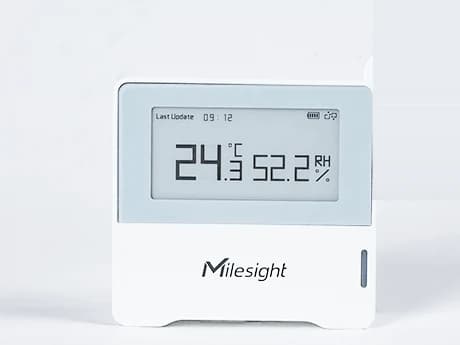
AM102
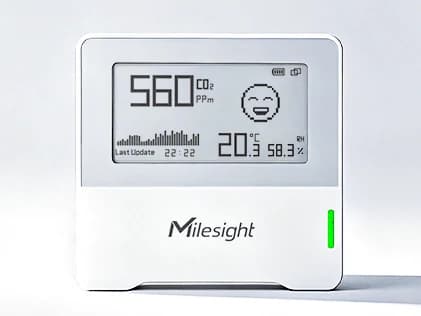
AM103
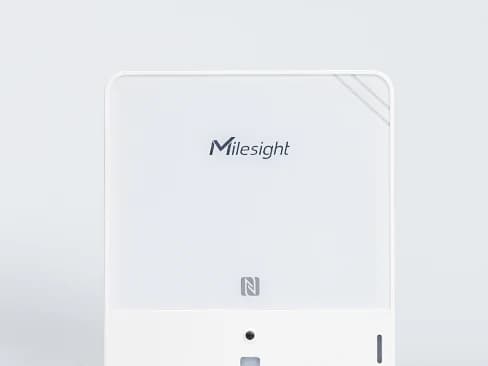
AM304L
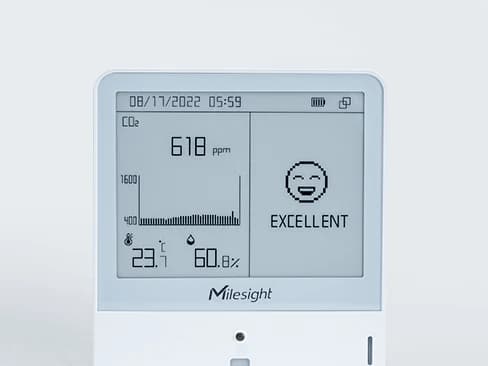
AM307
In short
Quick rule: AM102 for temperature and humidity only; AM103 adds CO2 for ventilation monitoring. For occupancy-based energy savings (PIR and light), the screenless AM304L, or AM305L if CO2 is needed too. For a full IAQ station with a display, TVOC and pressure, AM307; add dust (PM2.5/PM10) with AM308 (screenless: AM308L). Where building standards such as WELL call for formaldehyde (HCHO) or ozone (O3), the USB-C-powered AM319.
Audience: Facility and energy managers monitoring indoor air quality and occupancy in offices, schools, hospitals, hotels and stores.
Which one is for you?
AM102
Room-level temperature and humidity, long battery life
- Temp + humidity
- 2.13-inch E-ink
- IP30
- AM102L: no screen
AM103
CO2-based ventilation monitoring in meeting rooms and classrooms
- CO2 (NDIR)
- Temp + humidity
- 2.13-inch E-ink
- AM103L: no screen
AM304L
Occupancy-based lighting and HVAC control
- 4 parameters
- PIR + light
- No screen
- Very long battery life
AM305L
Demand-controlled ventilation by occupancy and CO2
- 5 parameters
- CO2 (NDIR)
- PIR + light
- No screen
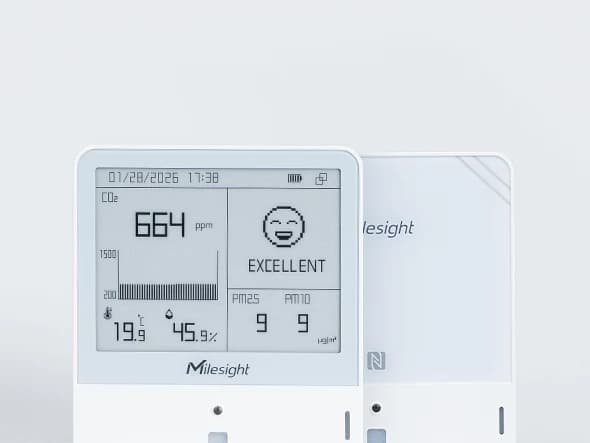
AM307
Full IAQ monitoring with a display in offices and schools
- 7 parameters
- TVOC + pressure
- 4.2-inch E-ink
- Battery or USB-C
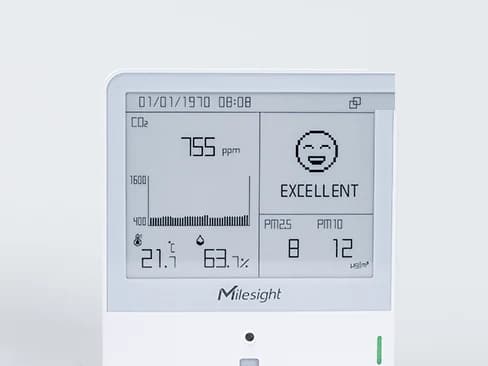
AM308 / AM308L
Spaces where dust and particulate matter matter too
- PM2.5 + PM10
- TVOC + CO2
- 4.2-inch E-ink (AM308)
- AM308L: no screen
AM319
Building standards such as WELL; formaldehyde or ozone
- 9 parameters
- HCHO or O3
- USB-C powered
- LoRaWAN Class C
All seven side by side
| Criterion | AM102 | AM103 | AM304L | AM305L | AM307 | AM308 / AM308L | AM319 |
|---|---|---|---|---|---|---|---|
| Temperature and humidity | Yes | Yes | Yes | Yes | Yes | Yes | Yes |
| CO2 | No | NDIR, 400–5000 ppm | No | NDIR, 400–5000 ppm | NDIR, 400–5000 ppm | NDIR, 400–5000 ppm | Photoacoustic, 400–2000 ppm |
| Motion (PIR) and light | No | No | Yes | Yes | Yes | Yes | Yes |
| TVOC and barometric pressure | No | No | No | No | Yes | Yes | Yes |
| PM2.5 and PM10 | No | No | No | No | No | Yes (laser scattering) | Yes (laser scattering) |
| HCHO or O3 | No | No | No | No | No | No | One of the two (electrochemical) |
| Display | 2.13-inch E-ink (AM102L: none) | 2.13-inch E-ink (AM103L: none) | None | None | 4.2-inch E-ink | AM308: 4.2-inch E-ink; AM308L: none | 4.2-inch E-ink |
| Power and battery (vendor claim) | 2 × 2700 mAh; over 7 years (SF7, 10 min) | 2 × 2700 mAh; about 4.5 years (SF7, 10 min) | 4 × 2700 mAh or USB-C; about 14 years (SF7, EU868, 10 min) | 4 × 2700 mAh or USB-C; about 11 years (SF7, EU868, 10 min) | 4 × 2700 mAh or USB-C; about 3.9 years (SF7, 10 min) | 4 × 2700 mAh or USB-C; about 1.3 years (SF7, 10 min) | USB-C (5 V / 1 A); no battery operation |
| On-device logging | 1,280 records | 640 records | 4,320 records | 4,320 records | 18,000 records | 18,000 records | 18,000 records |
| LoRaWAN class | Class A | Class A | Class A | Class A | Class A | Class A | Class C |
Source: manufacturer product pages. Range figures are vendor claims.
How to proceed
- 1
Decide which parameters you need
Temperature and humidity cover comfort (AM102). Ventilation needs CO2 (AM103, AM305L); building materials and cleaning chemicals call for TVOC (AM307); traffic or outdoor dust calls for PM2.5/PM10 (AM308).
- 2
Decide on a display
Choose E-ink models if occupants should see air quality; choose the screenless L versions, with longer battery life, if it is only watched from a central dashboard.
- 3
Plan power and reporting interval
The particulate sensor drains batteries fast: AM308 lasts about 1.3 years on battery, so USB-C power is recommended for frequent reporting. AM319 runs on USB-C only; plan a socket or USB adapter at the mounting point.
- 4
Check gateway coverage
The AM series talks LoRaWAN; indoors, one gateway (e.g. UG63, UG65) per floor or per few floors is usually enough. Turkey uses the EU868 frequency plan.
Included
- Comparison based on Milesight's official product pages and documents
- Recommendation by parameters, display and power needs
Not included
- Battery figures are vendor lab values; real life depends on reporting interval, SF and ambient temperature.
- The AM series is for indoor use (IP30); outdoor and industrial sites need other sensors. Request a quote for price and stock.
Related
Frequently asked questions
What is the difference between AM102 and AM103?
AM102 measures temperature and humidity only; AM103 adds CO2 (400–5000 ppm) with an NDIR sensor. Both have a 2.13-inch E-ink screen and a traffic-light indicator; the screenless versions are AM102L and AM103L.
What is the difference between AM307 and AM308?
Both measure temperature, humidity, motion (PIR), light, TVOC, barometric pressure and CO2. AM308 also measures PM2.5 and PM10 particulate matter with a laser-scattering sensor, which shortens its battery life (about 1.3 years vs about 3.9 years for AM307).
What are AM304L and AM305L for?
They are screenless occupancy and comfort sensors with long battery life. AM304L measures temperature, humidity, motion (PIR) and light; AM305L adds CO2. They are used to drive lighting, HVAC and ventilation by whether a room is occupied.
Why doesn't AM319 run on batteries?
AM319 uses an electrochemical formaldehyde (HCHO) or ozone (O3) sensor and LoRaWAN Class C, which keeps listening continuously, so it is powered over USB-C (5 V / 1 A). The HCHO sensor lasts 6 years and the O3 sensor 2 years; both are replaceable.
Which model suits the WELL Building Standard?
Milesight positions AM319 for WELL compliance; it measures the parameters in WELL's air quality features — CO2, PM2.5/PM10, TVOC and HCHO/O3 — in a single device.
Which gateway do AM series sensors work with?
Any standard LoRaWAN gateway and network server. They work directly with Milesight gateways such as UG63, UG65 or UG56; data can go to Milesight IoT Cloud or to your own system over MQTT/HTTP.
Ready with quantities and site notes? Send an RFQ — we reply in writing.
Request a quote