
IoTMarketi · Guides
LoRaWAN vs Zigbee: Choosing the Right Protocol for Industrial IoT Applications
LoRaWAN and Zigbee are the two most widely adopted wireless protocols in IoT deployments. Need long-range communication with minimal power consumption, or low-latency control with high security? This comparison helps you select the right protocol for your industrial IoT project.
LoRaWAN and Zigbee Network Architecture
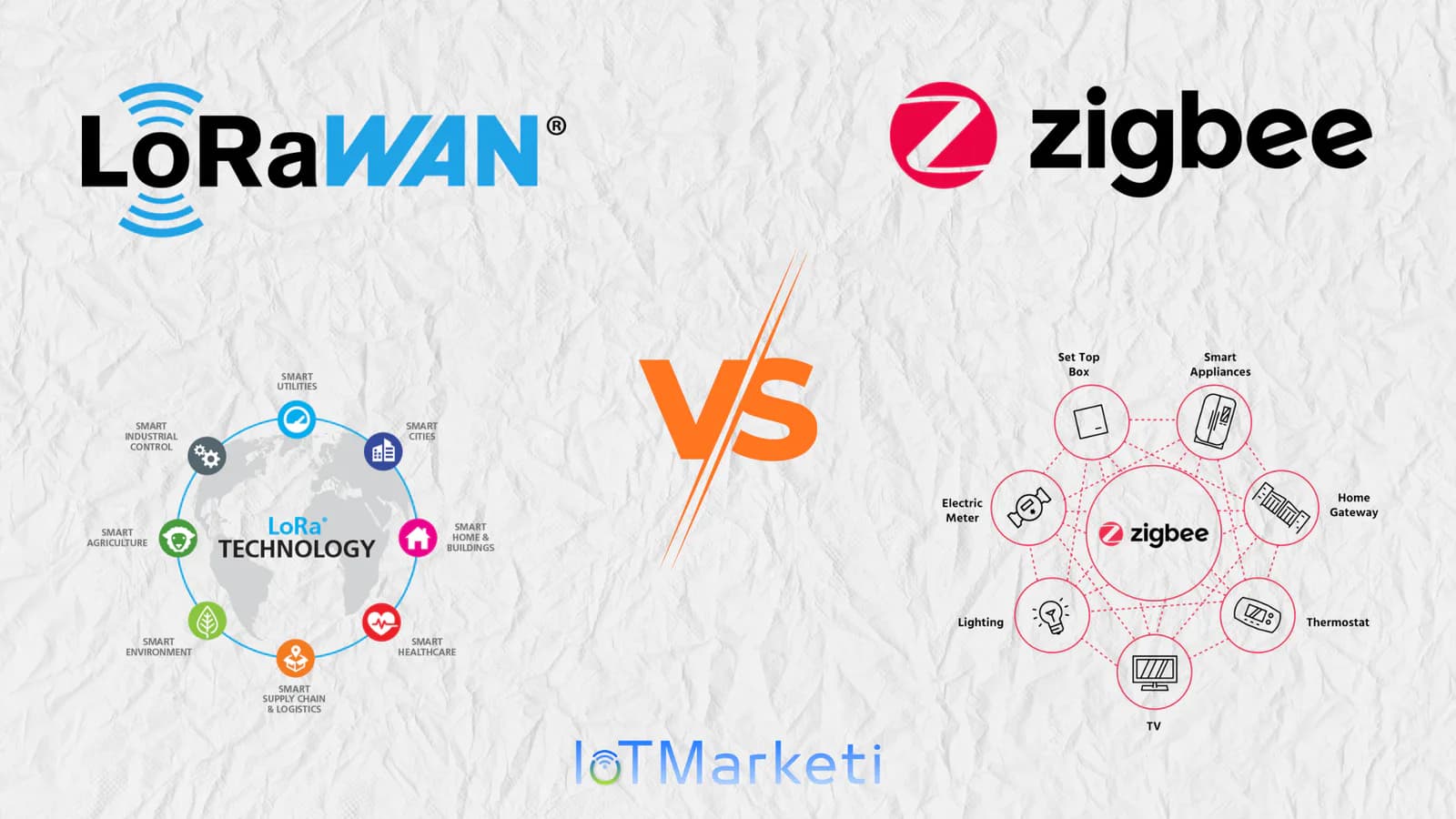
LoRaWAN operates on Low-Power Wide-Area Network (LPWAN) technology, enabling long-range connectivity with minimal power consumption. Using Spread Spectrum technology, devices can communicate across different frequencies within designated frequency bands. A LoRaWAN network comprises end device nodes, gateways, and a network server—an architecture that supports thousands of devices across large geographic areas.
Zigbee, by contrast, is based on the IEEE 802.15.4 physical radio specification and employs a mesh network topology for low-power, low-data-rate applications. Zigbee devices form networks by connecting wirelessly, with each device capable of acting as a repeater to facilitate data transmission.
What LoRaWAN and Zigbee Are Built For
LoRaWAN is designed for long-range communication supporting thousands of devices across vast areas. It excels in applications with low data rates—smart agriculture, asset tracking, and smart cities. LoRaWAN sensors deliver extended battery life (10+ years) and reliable data transmission over kilometers, making them ideal for remote and outdoor deployments. In Turkey's agricultural regions and large industrial facilities, LoRaWAN is increasingly the protocol of choice.
Zigbee is built for creating wireless control and monitoring systems within localized areas. Common applications include home automation, smart lighting, and industrial monitoring. Zigbee devices offer reliable, low-latency connections suitable for real-time control and automation.
Technical Feature Comparison
| Feature | LoRaWAN | Zigbee |
|---|---|---|
| Frequency Band | Sub-GHz unlicensed bands (868 MHz EU868) | 2.4 GHz (interference risk from other devices) |
| Communication Delay | High (due to long range) | Low (suitable for real-time applications) |
| Data Rate | Low (for energy efficiency) | High (for rapid data transmission) |
| Network Capacity | Thousands of devices, wide geographic area | High device density, limited area |
| Transmission Distance | Several kilometers | Several hundred meters |
| Topology | Star-of-stars | Star, tree, mesh, peer-to-peer |
| Power Consumption | Very low (10+ year battery life) | Low (frequent packet exchange increases consumption) |
| Cost | Fewer gateways required, lower deployment | More devices needed, complex network design |
LoRaWAN: Strengths and Limitations
Advantages:
- Extended range: LoRaWAN's primary strength is communication over large distances.
- Low power, long battery life: 10+ years of operation reduce maintenance and replacement frequency.
- High interference immunity: Spread Spectrum technology ensures multiple signals on the same frequency do not interfere with each other.
- Fast and easy deployment: Star-of-stars topology simplifies network setup and expansion.
Limitations:
- Not ideal for large data payloads: Low bandwidth restricts transmission of large files or high-resolution images.
- Unlicensed spectrum: Increasing LoRaWAN device deployments raise interference risk on shared frequencies.
- Security concerns: Network and application layers share the same root key, creating data privacy risks if private keys are compromised.
Zigbee: Strengths and Limitations
Advantages:
- Flexible network structure: Multiple topology options (star, mesh, tree) allow customization for different applications.
- High security: AES-128 encryption protects data transmission and prevents unauthorized access.
- Low latency: Fast response times make Zigbee ideal for real-time control applications.
Limitations:
- Limited range: Weak outdoor coverage and poor wall penetration restrict outdoor deployments.
- Higher setup cost: Covering large areas requires more devices and repeaters.
- Complex network management: Mesh topology can complicate network administration and device coordination.
Use Cases
LoRaWAN ideal applications:
- Smart agriculture and livestock monitoring
- Asset tracking in large industrial facilities
- Smart city infrastructure (water, electricity, gas metering)
- Environmental monitoring (air quality, humidity, temperature)
- Remote sensor networks
Zigbee ideal applications:
- Smart home automation
- Building management systems (HVAC, lighting)
- Industrial control and monitoring (in-factory)
- Real-time automation applications
Selecting the Right Protocol
When choosing between LoRaWAN and Zigbee, evaluate your project requirements:
- Geographic coverage: Wide outdoor areas → LoRaWAN; localized indoor spaces → Zigbee
- Data rate: Low-frequency, sparse data → LoRaWAN; high-frequency, dense data → Zigbee
- Battery life: Extended operation critical → LoRaWAN; power supply available → Zigbee
- Latency tolerance: High tolerance acceptable → LoRaWAN; low latency required → Zigbee
- Deployment cost: Minimal gateway infrastructure → LoRaWAN; high device density → Zigbee
For detailed guidance on LoRaWAN and Zigbee solutions for your industrial IoT projects in Turkey, submit a quote request on IoTMarketi. Our experts will help you select the right protocol and devices for your specific needs.
FAQ
Frequently Asked Questions
LoRaWAN nedir ve Zigbee'den farkı nedir?
LoRaWAN, Düşük Güç Geniş Alan Ağı (LPWAN) teknolojisine dayanan, uzun menzilli ve düşük güçlü iletişim protokolüdür. Zigbee ise mesh topolojisine dayanan, kısa menzilli ve düşük gecikme gerektiren uygulamalar için tasarlanmıştır. LoRaWAN binlerce cihazı geniş alanlarda desteklerken, Zigbee yerelleştirilmiş, gerçek zamanlı kontrol için uygundur.
LoRaWAN gateway nedir ve kaç tane gerekir?
LoRaWAN gateway, uç cihazlar ile ağ sunucusu arasında haberleşmeyi sağlayan ağ geçididir. Yıldız topolojisi nedeniyle, geniş bir alanı kapsamak için Zigbee'ye kıyasla çok daha az gateway gerekir. Kurulum maliyeti ve karmaşıklığı önemli ölçüde azalır.
LoRaWAN sensörleri ne kadar süre pil ile çalışır?
LoRaWAN sensörleri, düşük güç tüketimi sayesinde 10 yıldan fazla pil ömrü sağlayabilir. Bu, sık bakım ve pil değişimi ihtiyacını ortadan kaldırarak, uzak ve açık alan uygulamalarında maliyeti önemli ölçüde düşürür.
Türkiye'de LoRaWAN ve Zigbee hangi endüstrilerde kullanılıyor?
LoRaWAN, Türkiye'deki tarım, su/elektrik sayaçları ve geniş endüstriyel tesislerde yaygın olarak kullanılmaktadır. Zigbee ise akıllı bina yönetimi, fabrika içi kontrol ve ev otomasyonu uygulamalarında tercih edilmektedir.
IoTMarketi'den LoRaWAN ve Zigbee çözümü nasıl talep edebilirim?
IoTMarketi, Türkiye'deki B2B endüstriyel IoT kataloğu ve proje teklifi hizmetidir. Projenizin gereksinimlerini belirterek teklif talebinde bulunabilir, uzmanlarımızdan LoRaWAN gateway, sensör ve diğer cihazlar hakkında detaylı bilgi alabilirsiniz.
Continue reading
LoRaWAN and BACnet Integration: Connecting Wireless IoT Sensors to Smart Building Management Systems
LoRaWAN technology enables wireless sensors to integrate seamlessly with existing BACnet-based Building Management Systems (BMS) without expensive rewiring. This guide explores hybrid architecture, protocol conversion, and gateway workflows—a cost-effective, rapid solution for modernizing legacy buildings.

Why a Quote Model for IoT? B2B Catalog Without Shelf Prices
Why fixed shelf prices mislead in industrial IoT? IoTMarketi’s quote model: written offers by quantity, stock, integration and services — typically within 24 hours.
LoRaWAN Glossary: EU868, Class A/B/C, ADR, OTAA
Common LoRaWAN terms: EU868, Class A/B/C, ADR, OTAA/ABP, gateway, network server — short Turkey-field definitions with IoTMarketi catalog links.