
IoTMarketi · Guides
LoRaWAN and BACnet Integration: Connecting Wireless IoT Sensors to Smart Building Management Systems
LoRaWAN technology enables wireless sensors to integrate seamlessly with existing BACnet-based Building Management Systems (BMS) without expensive rewiring. This guide explores hybrid architecture, protocol conversion, and gateway workflows—a cost-effective, rapid solution for modernizing legacy buildings.
LoRaWAN and BACnet: The Foundation of Wireless Building Management
Facility managers face a familiar dilemma: modernize building data collection or absorb prohibitive rewiring costs. Integrating LoRaWAN with BACnet solves this problem. Wireless IoT sensors connect seamlessly to existing Building Management Systems (BMS) without expensive cabling infrastructure.
Research shows that operation and maintenance consume up to 70% of a building's lifecycle cost. Yet legacy wired BACnet systems often struggle to scale. Adding new capabilities—HVAC optimization, indoor air quality monitoring, occupancy tracking—to existing buildings becomes costly and disruptive. This is where LoRaWAN's wireless extension layer steps in. With low power consumption and extended range, it preserves existing BMS investments while eliminating rewiring complexity.
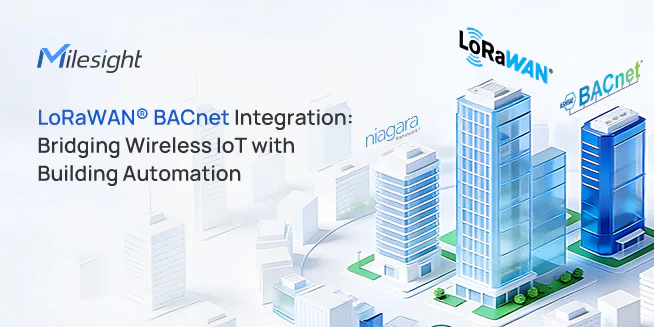
What Is BACnet and How Does It Work in Building Management Systems?
BACnet is a standardized communication protocol for building automation and control networks. Developed under ASHRAE Standard 135 and ISO 16484-5, it enables devices from different manufacturers to interoperate seamlessly. BACnet defines data exchange rules for HVAC, lighting, access control, and energy systems.
Unlike proprietary protocols that create vendor lock-in, BACnet uses an object-oriented model with over 60 standardized object types—analog inputs, binary outputs, schedules—to represent building data. Modern BMS implementations typically use BACnet/IP for high-speed backbones or BACnet MS/TP for field-level connectivity, ensuring flexible and scalable data exchange.
BACnet's true value lies in its role as a unifying communication layer. Because most software frameworks natively support BACnet, facility managers can break through vendor lock-in. In the past, a Siemens HVAC system meant being locked into Siemens controllers. BACnet shattered those silos. Now you can mix a Honeywell chiller, a Schneider lighting system, and a Johnson Controls thermostat on a single network to optimize energy and maintenance efficiency.
Challenges of Traditional Wired BACnet Networks
Physical Cabling Limitations
Traditional BACnet MS/TP networks rely heavily on the RS-485 electrical standard using a daisy-chain topology. In large facilities, maintaining signal integrity across long cable runs requires precise impedance matching and installation of termination resistors to prevent signal reflection. Moreover, the token-passing nature of MS/TP means that adding too many devices to a single bus introduces significant latency. A single break in the chain or a ground loop issue can bring down an entire network segment.
High Deployment and Retrofit Costs
The financial burden of wired infrastructure is a major barrier. Installing wired BACnet sensors involves significant labor costs for trenching, drilling, and running conduit. For existing buildings, this process is not only expensive but also disruptive to tenants. The cost per data point for a wired solution can be exponentially higher than wireless alternatives, making comprehensive retrofits budget-prohibitive for many property owners.
Lack of Flexibility in Dynamic Building Environments
Wired systems are inherently rigid due to hard-wired constraints. Once a sensor is wired into a specific location, moving it requires calling a contractor and physically re-routing the connection. In dynamic environments like flexible office spaces or modular warehouses where layouts change frequently, this lack of agility is a serious drawback.
What Is LoRaWAN and Why Is It Ideal for Smart Buildings?
LoRaWAN (Long Range Wide Area Network) is a standardized LPWAN protocol specifically engineered for the Internet of Things (IoT). Unlike short-range protocols like Wi-Fi or Bluetooth, LoRaWAN utilizes sub-GHz frequencies to transmit telemetry data over vast distances with minimal power consumption.
In a building context, LoRaWAN employs a star-of-stars topology, where end nodes (sensors) communicate directly with a central gateway. This architecture creates a robust, independent network layer that does not rely on the building's existing IT infrastructure, ensuring that facility monitoring data remains isolated, secure, and reliable. For building operators, LoRaWAN bridges the gap between the physical world and digital control systems, enabling seamless integration. It is optimized for devices that send small payloads—meter readings, air quality metrics, occupancy status—allowing for massive network scalability without clogging bandwidth.
Advantages of LoRaWAN in Building Scenarios
Superior Penetration for Complex Structures
Commercial buildings present challenging RF environments, filled with concrete, steel, and interference. LoRaWAN's sub-GHz frequency offers excellent physical penetration characteristics, allowing signals to reach "hard-to-access" areas like underground basements, mechanical plant rooms, and enclosed elevator shafts. A single gateway can typically provide redundant coverage for a multi-story high-rise or a sprawling campus, eliminating the need for the complex mesh of repeaters often required by other wireless technologies.
Extended Battery Life and Low Maintenance OpEx
Operational Expenditure (OpEx) is a key concern in large-scale deployments. LoRaWAN devices operate on a "sleep-mode" basis, waking up only to transmit data before returning to a low-power state. This efficiency allows battery-powered sensors to operate for 5 to 10 years, depending on the transmission interval. For facility managers, this means a "deploy-and-forget" lifecycle, drastically reducing labor costs and logistical headaches associated with frequent battery replacements across thousands of endpoints.
Non-Invasive Retrofitting (Low CapEx)
Modernizing legacy buildings with wired BMS solutions often involves costly, disruptive works such as trenching, drilling, and installing conduit. LoRaWAN enables non-invasive retrofitting, allowing sensors to be deployed rapidly without damaging existing decor or infrastructure. This wireless flexibility significantly reduces Capital Expenditure (CapEx) and accelerates project timelines, making it feasible to digitize older properties or heritage sites where structural modifications are restricted or cost-prohibitive.
Robust Security Standards
Security is paramount when integrating IoT into building infrastructure. LoRaWAN features built-in AES-128 end-to-end encryption, ensuring data integrity from the sensor to the application server. This architecture employs dual-layer security, where Network Session Keys verify the device's authenticity, while Application Session Keys ensure that payload data remains private. This standard meets the rigorous security compliance requirements of modern enterprise and government facilities.
How LoRaWAN and BACnet Work Together
Integration works by combining LoRaWAN's wireless data collection capabilities with BACnet's standardized building automation protocol. The data flow follows these steps:
The Data Journey: Step by Step
- Wireless Transmission: Battery-operated sensors capture environmental data and transmit it wirelessly via LoRaWAN radio waves to the central gateway.
- Protocol Conversion: The gateway receives these encrypted payloads and instantly converts them into standard BACnet/IP objects (such as Analog Inputs).
- BMS Recognition: To the central Building Management System, these wireless sensors are virtually indistinguishable from wired ones; they appear simply as new devices on the network map.
- Bidirectional Protocol Translation: The gateway seamlessly converts LoRaWAN payloads into standard BACnet Object Instances (Analog/Binary Inputs) and vice versa, enabling the BMS to both read sensor data and send control commands to wireless actuators.
- Data Buffering & Storage: Reliability is key. If the connection to the BMS is temporarily lost, the gateway can cache sensor data locally. Once the network is restored, it automatically uploads the backlog, preventing critical data gaps in historical logs.
- Data Collection (Uplink): LoRaWAN sensors broadcast encrypted telemetry data via RF to the gateway.
- Local Decoding & Mapping: The gateway's internal decoder parses the hex payload. Using the embedded mapping tool, it assigns these values to specific BACnet IDs (e.g., Zone1_Temp maps to Analog_Input:101).
- BMS Polling: The BMS scans the network via BACnet/IP and discovers the gateway as a native controller, pulling the pre-processed data instantly.
LoRaWAN vs. Other Wireless Technologies for BMS
When it comes to BMS integration in building applications, LoRaWAN's advantages are clear:
- Range: LoRaWAN can reach 2–15 km; Bluetooth and Wi-Fi are limited to a few hundred meters.
- Power Consumption: LoRaWAN sensors offer 5–10 years of battery life; Bluetooth and Wi-Fi devices require frequent charging.
- Scalability: A single LoRaWAN gateway can support thousands of sensors; Wi-Fi networks are limited by device count.
- Standardization: LoRaWAN is an open standard, reducing vendor lock-in; proprietary protocols carry lock-in risk.
Common LoRaWAN–BACnet Use Cases in Building Applications
HVAC System Control
LoRaWAN sensors measure temperature and humidity in each zone. Data flows through the gateway to the BMS. The system optimizes heating/cooling by zone. Energy savings range from 15–25%.
Multi-Building Campus Management
A university or corporate campus deploys one LoRaWAN gateway per building instead of running cables between buildings. The central BMS monitors the entire campus from a single interface. Adding new buildings is as simple as deploying a gateway.
Energy Management and Monitoring
LoRaWAN electric, water, and gas meters provide real-time consumption data. The BMS detects anomalous usage and sends alerts. Facility managers use the data for leak detection and demand-side management.
Advanced Capabilities: Edge Intelligence and Data Reliability
Milesight LoRaWAN gateways provide local data processing (edge computing) at the gateway. Sensor data is filtered, aggregated, and processed before being sent to the cloud. This reduces bandwidth and minimizes latency. Additionally, if network connectivity is lost, the gateway stores data locally and synchronizes when connectivity is restored.
What Is a LoRaWAN–BACnet Gateway and How Does It Work?
The gateway acts as a translator between LoRaWAN and BACnet. It receives encrypted payloads from wireless sensors, decrypts them, and converts them into standard BACnet objects. The BMS sees these objects as local network devices.
Milesight LoRaWAN Gateways: Professional Solutions
Milesight offers LoRaWAN gateways designed for commercial and industrial applications. The UG65 Indoor LoRaWAN Gateway is suited for commercial spaces like offices and hotels, featuring a sleek design and a quad-core processor. Internal Node-RED support provides a flexible choice for smart building logic.
The gateway performs these functions:
- Data Collection (Uplink): LoRaWAN sensors broadcast encrypted telemetry data via RF to the gateway.
- Local Decoding & Mapping: The gateway's internal decoder parses the hex payload. Using the embedded mapping tool, it assigns these values to specific BACnet IDs (e.g., Zone1_Temp maps to Analog_Input:101).
- BMS Polling: The BMS scans the network via BACnet/IP and discovers the gateway as a native controller, pulling the pre-processed data instantly.
Optimizing Integration with the Niagara Framework and Driver
Niagara is an industry-standard framework for building automation software. The Milesight Niagara Driver seamlessly integrates the LoRaWAN gateway into the Niagara platform. Facility managers can view, control, and analyze sensor data without writing a single line of code.
The Role of the Niagara Framework in Modern BMS
Niagara provides a unifying layer across different protocols (BACnet, Modbus, OPC-UA) and devices. The Milesight Driver maps LoRaWAN sensors into Niagara's object model. Facility managers can create graphs, reports, and alerts—all from a single platform.
The Power of the Milesight Niagara Driver
The driver automatically converts LoRaWAN payloads into BACnet objects. Mapping rules are defined within the gateway. Niagara reads these rules and presents sensor data as standard BACnet Analog Inputs. The result: existing BMS software works unchanged.
Why Choose a Hybrid LoRaWAN & BACnet Architecture?
Cost-Efficient Retrofitting
Modernizing legacy buildings with traditional wired solutions can cost millions. LoRaWAN enables non-invasive, rapid deployment. Sensors are installed with adhesive or magnetic mounts. No cabling work required.
Rapid, Non-Disruptive Deployment
Wired systems disrupt tenants and operations during installation. LoRaWAN can be deployed while tenants continue working. Project timelines shrink from weeks to days.
Agile Scalability
Need to add a new wing or building? Deploy sensors and add them to the gateway. The BMS automatically discovers new devices. No rewiring required.
Unified Multi-Building Management
Across a campus, the central BMS monitors all buildings. Energy consumption, HVAC performance, and occupancy status are visible on a single dashboard. Facility managers can optimize resources and reduce costs.
Success Stories and Real-World Applications
Milesight's LoRaWAN–BACnet solution has transformed building management across the globe. Commercial offices, hospitals, and universities have reduced energy costs while increasing operational efficiency. The hybrid architecture preserves existing BMS investments and provides a scalable path forward.
Ready to modernize building management in Turkey? Request a quote for LoRaWAN and BACnet integration through IoTMarketi. Our experts will design a solution tailored to your building's needs and guide you through deployment.
FAQ
Frequently Asked Questions
LoRaWAN nedir ve BACnet ile nasıl çalışır?
LoRaWAN (Uzun Menzil Geniş Alan Ağı), IoT cihazları için tasarlanmış düşük güç, uzun menzilli bir protokoldür. BACnet ile entegre olduğunda, kablosuz sensörlerin verilerini standart bina otomasyon protokolüne dönüştürerek, mevcut BMS sistemlerine sorunsuz bağlantı sağlar. Ağ geçidi, bu iki protokol arasında çevirmen görevi görür.
Kablolu BACnet sistemlerine kıyasla LoRaWAN'ın avantajları nelerdir?
LoRaWAN, pahalı kablolama işlerine gerek kalmadan hızlı dağıtım sağlar. Sensörler 5–10 yıl pil ömrü sunar, işçilik maliyetlerini azaltır. Eski binaların tahribatsız retrofit edilmesini sağlar ve binalar arasında esneklik sunar. Ayrıca, sub-GHz frekansı beton ve çelik gibi engelleri penetre eder.
Milesight LoRaWAN ağ geçidi hangi özellikleri sunar?
Milesight UG65 gibi ağ geçitleri, dört çekirdekli işlemci, dahili Node-RED desteği ve yerel veri işleme (edge computing) özellikleri ile gelir. Sensör verilerini otomatik olarak BACnet nesnelerine dönüştürür ve ağ bağlantısı kesilirse verileri yerel olarak depolar.
LoRaWAN–BACnet entegrasyonu ile ne kadar enerji tasarrufu sağlanabilir?
Bina türü ve uygulamaya bağlı olarak, enerji tasarrufu %15–25 arasında değişebilir. Özellikle HVAC sistemlerinin bölge bazında optimize edilmesi ve gerçek zamanlı izleme, önemli maliyetleri azaltır.
Türkiye'de LoRaWAN ve BACnet entegrasyonu için nasıl teklif alabilirim?
IoTMarketi aracılığıyla LoRaWAN ve BACnet çözümleri için teklif talep edebilirsiniz. Uzmanlarımız, binanızın ihtiyaçlarını değerlendirir, uygun bir sistem tasarlar ve dağıtım sürecinde rehberlik eder.
Continue reading

LoRaWAN Glossary: EU868, Class A/B/C, ADR, OTAA
Common LoRaWAN terms: EU868, Class A/B/C, ADR, OTAA/ABP, gateway, network server — short Turkey-field definitions with IoTMarketi catalog links.
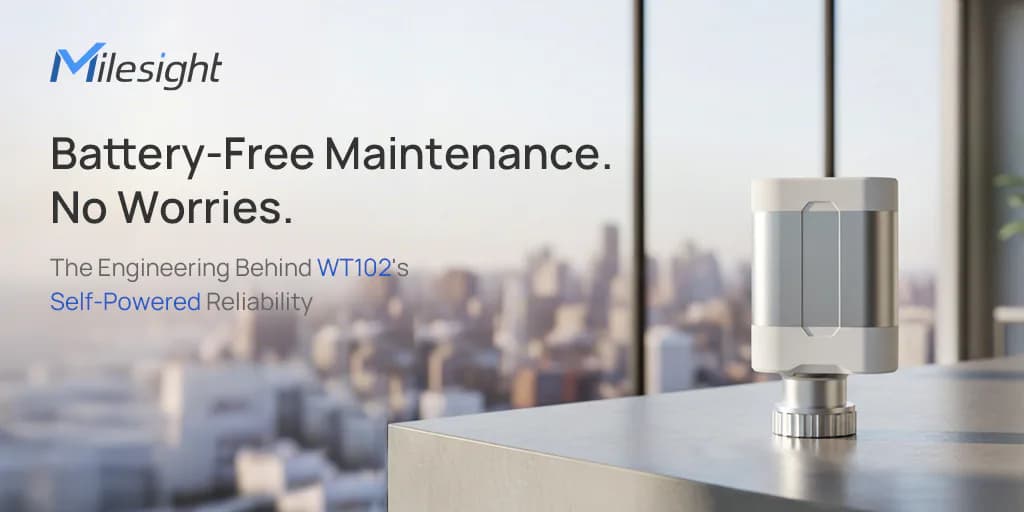
Milesight WT102 Smart Radiator Thermostat Reliability: Technical Q&A
How does the Milesight WT102 smart radiator thermostat operate continuously without batteries? Discover the engineering behind industrial-grade reliability: thermoelectric energy harvesting, supercapacitor buffering, and local autonomous control that keeps your HVAC running—no maintenance, no manual resets.

Milesight EV Charging Station Management: The Path to Carbon Neutrality
Electric vehicles are the foundation of carbon neutrality. Milesight's industrial IoT solution enables remote management of decentralized charging stations, improving energy efficiency, reducing maintenance costs, and lowering carbon emissions. How do LoRaWAN and 4G/3G-connected smart gateways work for Turkey's rapidly expanding EV infrastructure?