
IoTMarketi · Guides
LoRaWAN Hotel HVAC Reliability: 100 Rooms, 200,000 Tests, 99.26% Success
Milesight validated LoRaWAN-based HVAC control across 100 hotel rooms in a rigorous 135-hour stress test, achieving a 99.26% link success rate over 202,111 communication cycles. This large-scale reliability benchmark demonstrates LoRaWAN's readiness for industrial IoT deployments in hospitality and beyond.
Proving LoRaWAN Reliability in Hotel Automation
It's 2 a.m. in a hotel room. The guest checked out six hours ago, but the fan coil unit is still running at full capacity. According to ENERGY STAR research, hotel rooms sit unoccupied for an average of 12 hours per day, while HVAC systems account for 30 to 50 percent of a hotel's total energy consumption. Occupancy-based control — switching to energy setback when a guest leaves and returning to comfort settings on arrival — is the most direct way to close that gap.
Wireless technology can do this. But hotel operators and system integrators need to know whether it works reliably at scale, room by room, floor by floor. A rigorous test conducted by Milesight was designed to answer exactly this question: how reliable is LoRaWAN in a dense, multi-floor hotel environment with hundreds of simultaneous devices?
Why LoRaWAN Needed Proof
A leading hospitality system integrator approached Milesight with existing benchmarks from two competing wireless technologies:
| Technology | Communication Success Rate |
|---|---|
| Zigbee | 99% |
| Wi-Fi | 100% |
| LoRaWAN | ? |
LoRaWAN offered real advantages for hotel deployment: no new cabling required, better range across floors, lower infrastructure cost, and ultra-low power consumption enabling multi-year battery life on sensors. Yet in a dense, multi-floor environment with hundreds of simultaneous devices, real-world reliability had never been formally documented.
Milesight designed a test rigorous enough to deliver a definitive answer — not just for this client, but for every system integrator evaluating LoRaWAN at hotel scale.
System Architecture
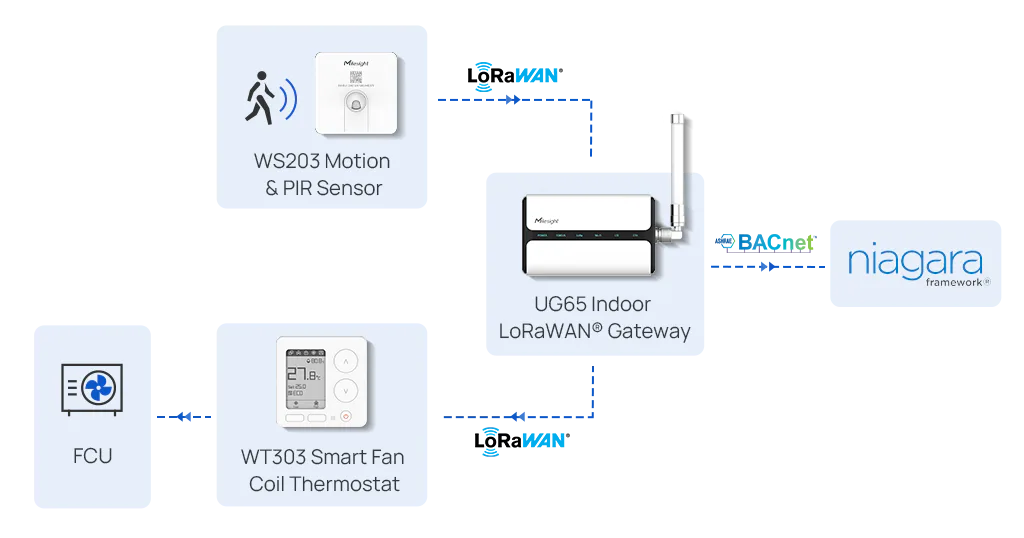
The test modeled a complete three-floor, 100-room hotel on the US915 frequency band. The deployment included 100 WT303 smart fan coil thermostats, 100 WS203 motion and temperature sensors, and 2 UG65 LoRaWAN gateways in a primary/secondary configuration. Over 135 hours of uninterrupted operation, 202,111 total communication cycles were logged.
Each cycle followed a complete occupancy control loop: the WS203 detects guest presence and reports room status, the UG65 processes the signal through Node-RED automation logic and dispatches a setpoint command to the WT303, and the WT303 executes the adjustment and returns an ACK confirmation. Every link had to close for a cycle to count as a success. A missed uplink, failed downlink, or unconfirmed execution all counted against the score.
Test Conditions and Real-World Scenario
This was not a proof-of-concept with a handful of nodes in a clean RF environment. Throughout the test, 154 external devices actively transmitted on the same frequencies — a realistic representation of shared-spectrum RF conditions in an actual hotel. These devices were not filtered out. The numbers returned are from a real-world RF environment, not an isolated chamber.
Spreading factor selection, retry logic, gateway configuration, and reporting intervals were all tuned and re-tested before the final 135-hour validation run. The full methodology is documented in the test report.
Results: Reliability Proven at Scale
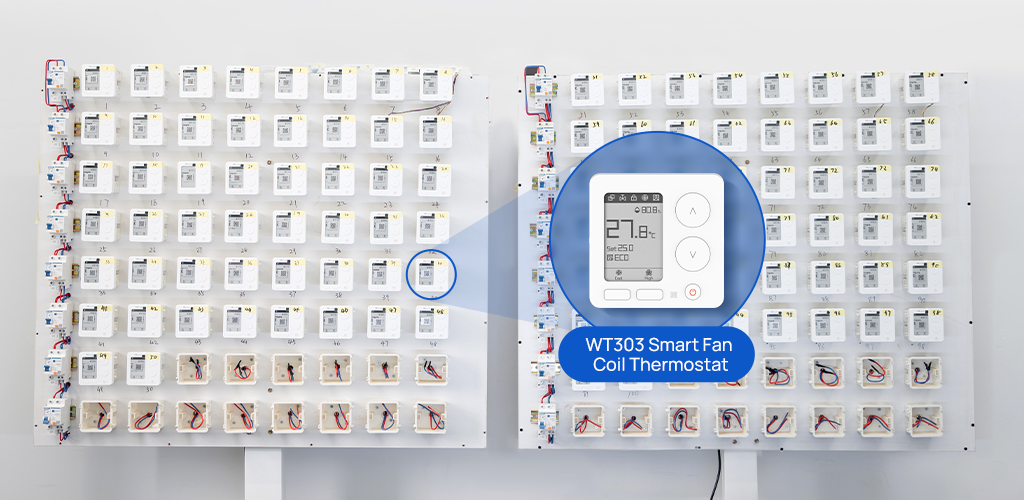
- 99.26%: Overall system link success rate across 202,111 data cycles
- 100%: Device online rate maintained throughout the full 135-hour run
- 72 out of 100: Device pairs achieving ≥99% individual success rate
- 100%: FUOTA (Firmware Update Over The Air) success across all 100 thermostats, completed within 2 hours
The 72 out of 100 figure reflects stress-test conditions: in this test, the WS203 reported on a fixed periodic schedule to maximize data volume — generating significantly higher channel load than a real hotel deployment would ever produce. In practice, sensors only transmit when occupancy status actually changes, meaning far less channel congestion and more reliable message delivery.
Under standard default configuration — the baseline any integrator would start from — all room pairs are capable of reaching ≥99% individual success rate.
Practical Meaning for Hotel Operations
A 99.26% success rate across 200,000 interactions translates directly into outcomes that matter for hotel operations:
1. Reliable guest comfort from check-in Occupancy control engages the moment a guest enters, every time. No delays, no missed triggers, no rooms that fail to respond when it counts.
2. Consistent unoccupied setback When a guest checks out or leaves the room, the setback command reaches the thermostat reliably. The energy savings that make occupancy automation worth deploying depend entirely on this link holding — and this test confirms it does.
3. Deployment confidence at scale For system integrators taking this solution to hotel clients, the reliability question now has a documented, reproducible answer, validated under conditions that reflect actual deployment environments, and available to share before any project commitment.
Complete LoRaWAN Hotel Automation Ecosystem
The WS203 and WT303 are part of a broader Milesight LoRaWAN solution designed for hospitality environments. Smart thermostats work alongside occupancy sensors, door and window sensors, indoor air quality sensors, and light sensors to build a fully connected guest room — where every climate decision is informed by real-time room state.
All data is simultaneously transmitted through Milesight LoRaWAN gateways to cloud platforms or BMS infrastructure via standard protocols, including BACnet, forming a complete hotel building automation system. The result is measurable improvement in both guest comfort and energy efficiency, without adding complexity to day-to-day hotel operations.
Planning a hotel deployment and want to model your specific scenario before going to site? Through IoTMarketi, you can connect with Milesight experts for project assessment and quotation. Submit your requirements via our request form and receive a project evaluation within 24 hours.
Frequently Asked Questions
What is LoRaWAN and why is it suitable for hotel HVAC control? LoRaWAN is a long-range, low-power IoT protocol. In hotel environments, it requires no new cabling, provides reliable signal transmission across floors, and enables multi-year battery life on sensors. This test proved it operates at 99.26% reliability at scale (100+ devices).
How do these test results apply to real hotel deployments? The test was conducted under stress conditions (fixed periodic reporting). In real deployments, sensors transmit only when status actually changes, resulting in less channel congestion and higher success rates. Under standard configuration, all device pairs can achieve ≥99% success rate.
What is a LoRaWAN gateway and how many are needed? A LoRaWAN gateway receives signals from sensors and relays them to the network. In this test, 2 UG65 gateways (primary/backup) covered a 100-room building. Larger hotels may require additional gateways depending on building layout and RF conditions.
What is FUOTA (Firmware Update Over The Air)? FUOTA is a method for remotely updating device firmware without physical access or cabling. In this test, 100 thermostats were successfully updated within 2 hours — enabling maintenance without operational disruption.
Where do I start with a LoRaWAN-based hotel project in Turkey? IoTMarketi provides quotation and consulting services for hotel automation projects using Milesight LoRaWAN sensors and gateways. Share your specific requirements via our request form and receive a project assessment within 24 hours.
Hardware
Related products
Catalog hardware that fits this solution — request a quote for availability.
 MilesightSmart Building
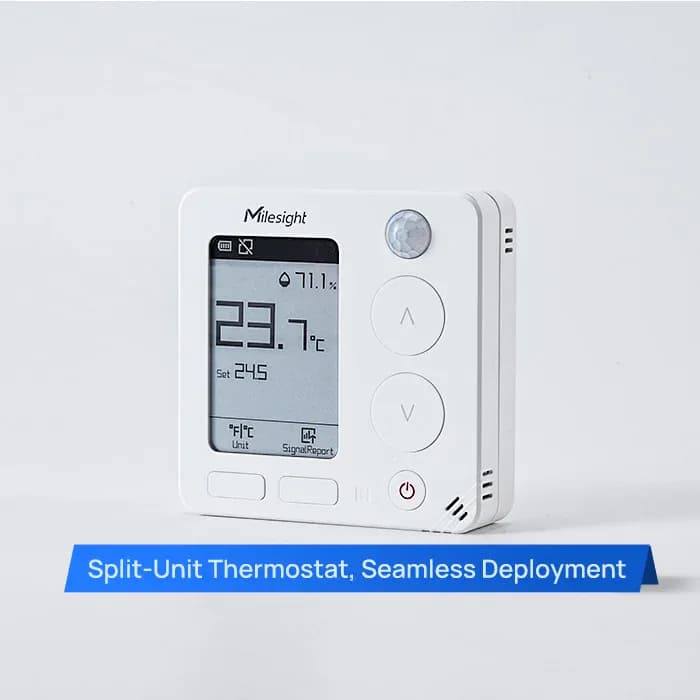
WT401 Wireless Smart Thermostat
Milesight WT401 is a wireless smart thermostat with split-unit design, eliminating wired installation costs. LoRaWAN-enabled with universal HVAC compatibility, PIR occupancy sensing, and 8 customizable schedules. Request a project quote via IoTMarketi in Turkey.
On Order
 MilesightSmart Building
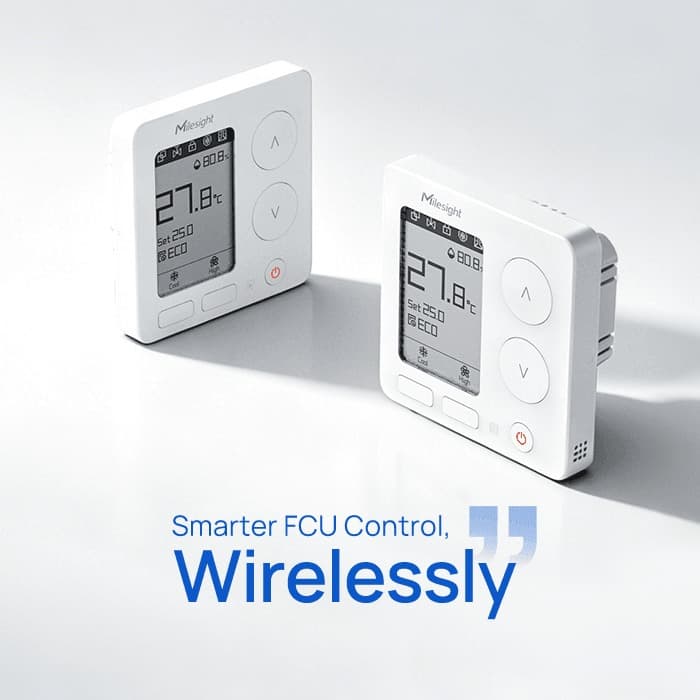
Milesight WT304 LoRaWAN Fan Coil Termostatı
LoRaWAN smart fan coil thermostat for 2-pipe and 4-pipe FCU systems — centralized climate control and energy optimization. Request a project quote.
On Order
- MilesightSmart Building
Milesight WT303 LoRaWAN Fan Coil Termostatı
Milesight WT30x — LoRaWAN smart fan coil thermostat for 2-pipe and 4-pipe FCU systems, EC and 3-speed fan control, centralized management and energy optimization. Request a project quote for your IoT deployment in Turkey.
On Order
 MilesightSmart Building
Milesight WT201 LoRaWAN Akıllı Termostat (HVAC)
LoRaWAN Sensör — Smart Thermostat
On Order
 MilesightSmart Building
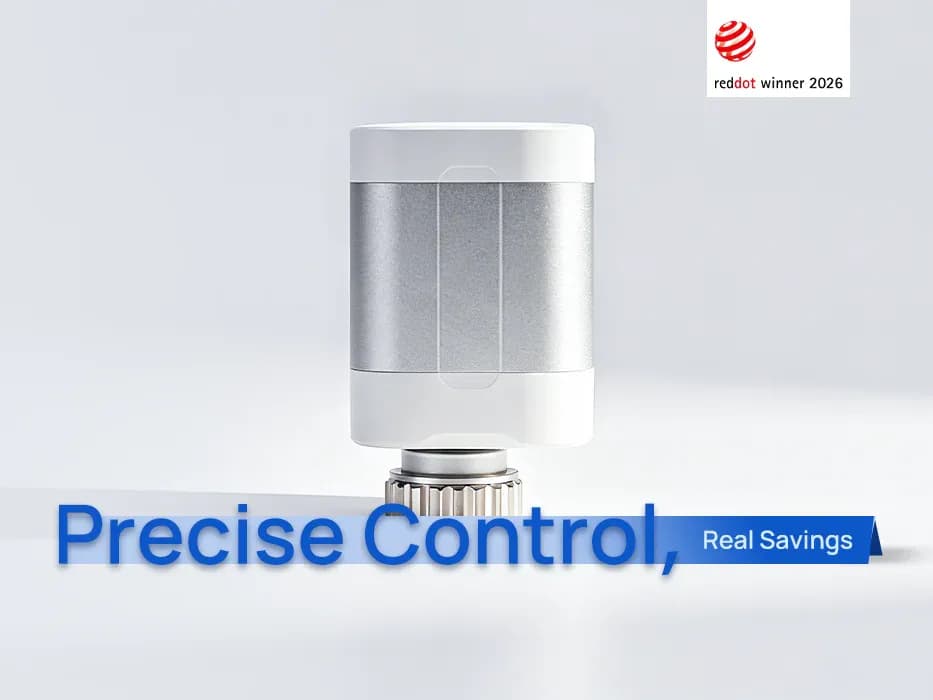
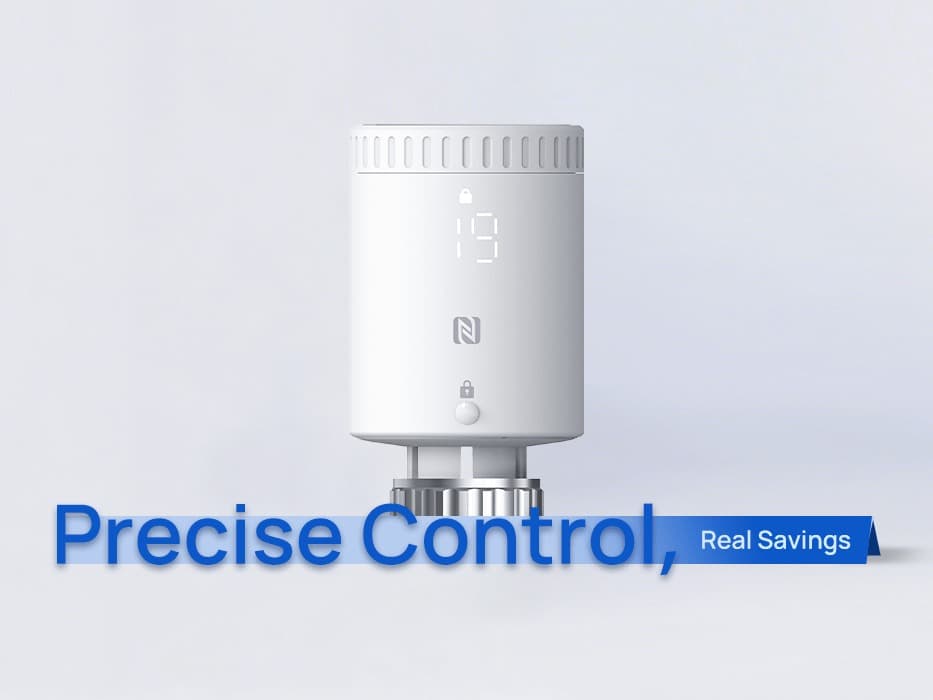
Milesight WT10x LoRaWAN Akıllı Radyatör Termostatı
LoRaWAN Smart Radiator Thermostat — WT102 energy harvesting for precise room temperature control and automated energy savings. Request a project quote.
On Order
 MilesightSmart Building
Milesight WT10x LoRaWAN Akıllı Radyatör Termostatı
LoRaWAN Smart Radiator Thermostat — Precise temperature control, energy harvesting (WT102), open window detection. Request a quote for your building automation project.
On Order
 MilesightGateway
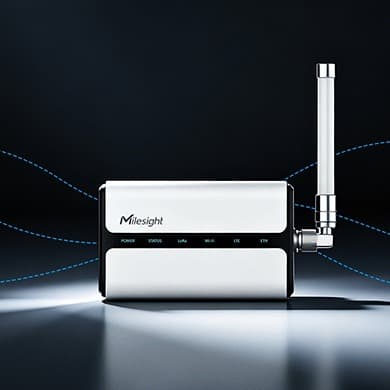
Milesight UG65 İç Mekan LoRaWAN Gateway (IP65)
8-channel industrial LoRaWAN gateway with PoE, 4G/Wi-Fi, IP65 rating — for smart buildings and large-scale IoT. Request a quote.
In Stock
 MilesightSensor
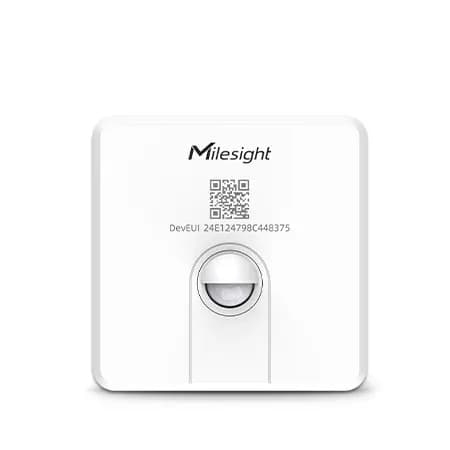
WS203 LoRaWAN Motion & Temperature-Humidity Sensor
The Milesight WS203 is a LoRaWAN motion, temperature, and humidity sensor for smart buildings and industrial applications. Multi-function environmental monitoring with energy-saving capabilities.
On Order
FAQ
Frequently Asked Questions
LoRaWAN nedir ve otel HVAC kontrolü için neden uygun?
LoRaWAN, uzun menzilli, düşük güç tüketimli bir IoT protokolüdür. Otel ortamında yeni kablolama gerektirmez, katlar arasında güvenilir sinyal iletişi sağlar ve sensörlerde çok yıllı pil ömrü sunar. Milesight'ın testi, ölçekte (100+ cihaz) %99,26 güvenilirlikle çalıştığını kanıtlamıştır.
Bu test sonuçları gerçek otel dağıtımlarına nasıl uygulanır?
Test, stres koşullarında (sabit periyodik raporlama) yapıldı. Gerçek dağıtımlarda sensörler yalnızca durum değiştiğinde iletim yapar, bu da daha az kanal tıkanıklığı ve daha yüksek başarı oranı anlamına gelir. Standart konfigürasyonda tüm cihaz çiftleri %99 ve üzeri başarı oranına ulaşabilir.
LoRaWAN gateway nedir ve kaç tane gerekli?
LoRaWAN gateway, sensörlerden sinyalleri alan ve bunları ağa ileten bir ağ geçididir. Bu testte 2 UG65 gateway (birincil/yedek) 100 odalı bir yapıyı kapsadı. Daha büyük oteller için bina düzeni ve RF koşullarına bağlı olarak ek gateway'ler gerekebilir.
FUOTA nedir ve neden önemli?
FUOTA (Firmware Update Over The Air), tüm cihazlara kablolama olmadan uzaktan yazılım güncellemesi gönderme yöntemidir. Bu testte 100 termostat 2 saat içinde başarıyla güncellenmiştir — otel operasyonlarında kesinti olmaksızın bakım yapılabilir anlamına gelir.
Türkiye'de LoRaWAN tabanlı otel projesi için nereden başlamalı?
IoTMarketi, Milesight LoRaWAN sensörleri ve gateway'leri ile otel otomasyon projeleriniz için teklif ve danışmanlık hizmeti sunar. Spesifik ihtiyaçlarınızı talep formu aracılığıyla paylaşarak, 24 saat içinde proje değerlendirmesi alabilirsiniz.
Continue reading
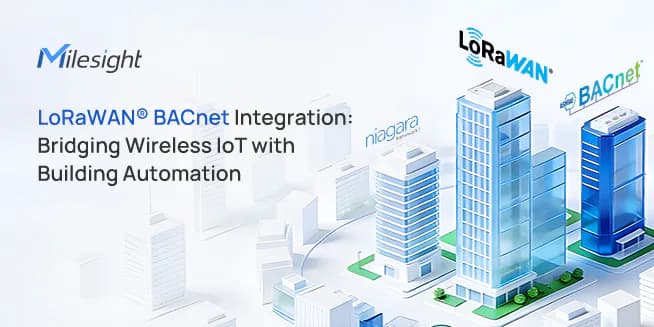
LoRaWAN and BACnet Integration: Connecting Wireless IoT Sensors to Smart Building Management Systems
LoRaWAN technology enables wireless sensors to integrate seamlessly with existing BACnet-based Building Management Systems (BMS) without expensive rewiring. This guide explores hybrid architecture, protocol conversion, and gateway workflows—a cost-effective, rapid solution for modernizing legacy buildings.

Smart Building IoT: CO2, Occupancy, Energy and BACnet Bridges
Smart building IoT drives HVAC efficiency, indoor air quality and occupancy analytics. LoRaWAN sensors plus BACnet/MQTT bridges are common.

Why a Quote Model for IoT? B2B Catalog Without Shelf Prices
Why fixed shelf prices mislead in industrial IoT? IoTMarketi’s quote model: written offers by quantity, stock, integration and services — typically within 24 hours.